Followers

Showing posts with label culture. Show all posts

Sunday, February 3, 2013

Demon Dance


Today, February 3 is Setsubun, or Seasonal division in Japan. It is a festival held on one day before the start of spring according to the Japanese lunar calendar. For many centuries, Japanese people have been performing rituals with the purpose of chasing away evil spirits at the start of spring.
Today I went to Rosanji Temple in Kyoto to see this traditional ceremony. I waited and waited for about one hour to keep a good place to take pictures. With the big sound of the drum and the shell horns, the red, green and black demons appeared and started to dance slowly on the stage. I did my best to take better pictures. But until this time I was extremely exhausted from standing too long, so I left there to take a rest.
According to the information, these demons were thrown beans and kicked out later.

I dedicate this post to Scenic Sunday.

Tuesday, October 23, 2012

Paper Ornament MIZUHIKI

 
These paper ornaments are called 'Mizuhiki' in Japanese, which are traditional Japanese ornament for celebration. They are made of strong, thin twine made from Japanese paper. On the left one, you see a crane, and on the right a turtle. Both are symbolic animals of longevity and prosperity in Japan.
I took this picture in Kanazawa the other day.

This is part of Ruby Tuesday 2.


Thursday, October 4, 2012

Thursday Challenge...Culture


This week's theme of Thursday Challenge is 'culture' and I think this photo is good for it.
This procession is heading for the Shinto shrine in which the traditional Japanese-style wedding ceremony is held. I happened to see this procession at the Hokoku Shrine in Osaka last week. The first two people are musicians, the next four people are Shinto priests and maidens. The bride and groom, their parents and relatives were following. You see  women wearing traditional Japanese kimono.
This is part of Thursday Challenge.

I've had little time to be in the blog world these days. Soon I'll catch up with you!

Tuesday, July 24, 2012

Flower Umbrella Procession


Flower Umbrella Procession was held today July 24, which is a part of Gion Festival of Kyoto. Around 850 people including young children and beautiful ladies participated this procession.
Among them, I was perfectly fascinated with the beauty of  Geiko and Maiko.


Young children carried the portable shrine wearing the same happi coats and tenugui headbands.


I had a wonderful time to see Japanese beauties filled with red color.


This is part of Ruby Tuesday 2 and Our World Tuesday.

Saturday, June 23, 2012

Puppet Window


I hear Japanese animation is very popular in the world, but I don't know how popular they are. Probably many of you know more than me.
These are puppets of famous characters created by Hayao Miyazaki. I found this shop near Kiyomizu Temple, which features his creation. Among his wonderful fantasy movies, my favorites are "My Neighbor Totoro" and "Spirited Away." I remember my daughter watching Totoro every day when she was a little child. She saw it so coutless times that she could say the words without seeing the video at that time.
Do you remember Totoro?  OR do you like his movies?
This is linking up with Weekend Reflections.

Monday, May 28, 2012

Beginners


I took this picture in Gion, Kyoto in the early afternoon the other day. I suppose these kimono girls are beginner trainees to geisha , who have just started training this April, after graduating junior high school. They were on their way to the lesson of Japanese dance. For about five years every day they take various lessons regarding Japanese traditional arts such as Japanese dance, Japanese traditional song,  musical instrument, tea ceremony, flower arrangement, etc.
When their hair grow long enough to set in upright hairstyle, I'm sure they look quite different and more gorgeous. Look at the lady walking before them. She is called 'Maiko'.
To know more about maiko and geiko, please read this.

Thursday, May 17, 2012

Aoi Festival

This is the report of Aoi Festival held yesterday on May 16th in Kyoto. Basically it is annually held on May 15th, but due to the heavy rain, it was postponed to the following day.
Aoi Festival, or Hollyhock Festival is the annual festival of Shimogamo Shrine and Kamigamo Shrine. Along with the Gion Festival and the Jidai Matsuri (Festival of Ages), it is one of the three big festivals in Kyoto. Featured is a gorgeous parade in the style of the ancient Heian Court, everything in the parade is adorned with the hollyhock leaf crest, also called "aoi" _ thus the name of the festival. The parade leaves the Kyoto Imperial Palace at 10:30 in the morning. The 700-meter-long parade passes Shimogamo Shrine and heads for Kamigamo Shrine. This festival offers the opportunity to see the ancient time in Japan, so it makes a great tourist attraction.


   Nowadays, the massive procession illustrates the high regard. There are men on horseback, giant bouquets of flowers, ornately decorated ox drawn carts, and a large retinue of women in kimono accompanying the year's Saio.


this year's heroine, Saio
Traditionally, the Saio was a young female member of the imperial family who served as the high priestess of the Kamo Shrines. During festivals, the Saio performed rituals at the shrines. In the modern era, a different unmarried woman from Kyoto is selected each year to serve as Saio. She must go through purification ceremonies before the festival, and is taken through the procession on a palanquin.

I had a great time to watch the ancient time. I want to add one more thing. This parade is held without music, just quietly and solemnly.

Friday, May 4, 2012

Carp Streamer


 Tomorrow May 5 is Children's Day, a national holiday in Japan. Families with young boys put up koinobori, or carp streamers outside, and some display dolls patterned after historical warriors and heroes inside, to pray for success in life. (For girls, Hina Dolls are displayed on March 3. See my post on Hina Dolls.)
As there is a legend that carp swim up waterfall and become dragons, they represent strength and patience, and the reaching of a goal. Parents hoist carp streamers to wish for their boys' growth.

Every year various carp streamer festivals are held across Japan around this time. Today I went to Akutagawa River in Takatsuki city, located between Osaka and Kyoto, to see as many as 1000 large and small carp streamers. It's really fantastic to see so many carp streamers swimming in the sky. It was windy and a little rainy, so even more these carp looked as if they struggle to swim up into the dragon.


The picture below shows a common set for a family. Basically it consists of four streamers: simple streamer, three carp-shaped ones which represent father, mother and son. Add more, when another child is born.
The other day, I presented a set of carp streamers to my dear grandson, Rintaro. Tomorrow is his one-year-old birthday, too.

This is linking to Skywatch Friday.

Thursday, April 19, 2012

Bunraku Puppet Theater


Yesterday I went to the National Bunraku Puppet Theater in Osaka to see the traditional Japanese puppet performance, usually called "Bunraku" in Japanese.  I am a Bunraku fan because it is a very special world. It is unique in various points.

First, the story is narrated by a high-level chanter with the accompaniment of shamisen music, who changes his voice into various characters and attracts the audience.
Second, in most of the world's puppet theaters, great pains have been taken to hide the manipulation of the puppeteers from the audience. But in Bunraku, the manipulators appear openly, in full view
of the audience.
Third, furthermore, each puppet is manipulated by three puppeteers: main puppeteer(head and right hand), left puppeteer and third puppeteer (lower part).
Lastly, the theme is not for kids. Probably you imagine puppet play is mainly for kids, but the theme of Bunraku is for adults, such as  avenge, infidelity and double suicide. Far away from fantasy. Bunraku started in the 17th century when the third military government united Japan (Tokugawa era) and it was under a feudal system. At that time there was a clear status system and it was difficult to love freely. All the stories are based on the lives in the Tokugawa era. Samurai world.

The theater offers earphone guide service  so as to understand the story easily. English earphone guide service is available for YOU.
Enjoy Bunraku in English.


Saturday, March 24, 2012

Nishijin Fabric

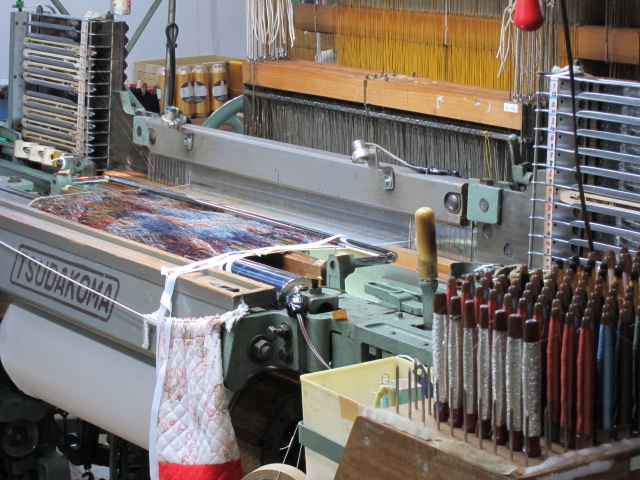
The other day I had an opportunity to visit a museum and two factories where Nishijin fabric is woven.

Nishijin fabric is a gorgeous, silk fabric and brocade produced in Nishijin district of Kyoto(not far from the Golden Pavilion). It has a long history of more than 1000 years to meet the demand of the Imperial court and aristocracy.


Nishijin fabric is most concisely characterized as diagonally woven and patterned fabrics made from died yarn so as to come out much richer colors.  Its production involves many complex processes and they can be divided into five major areas: planning and making Mon (design sheet which guides the design structure to the loom during weaving), preparation of materials (including dyeing thread), preparation of looms, weaving, and finishing. Each of these processes is carried out by specialists working in a production network based on the division of labor.


The high-class quality of Nishijin fabric is compared with Lyon silk from France and Milan silk from Italy. Today it is used for not only for kimono and obi sash, but also for tie, handbag, shawl and many others.


I was able to hear the story of  several people in the different processes. And I understand their craftsmanship has been in a family for generations, but today young people wouldn't succeed any more because of its hard work. So they all are concerned about the industry future.  Worrisome prospect.


famous "Big Wave" by  Hokusai


Thursday, March 15, 2012

Floral Friday Fotos


Ume apricot is a symbol of the Tenmangu Shrines, so many ume blossoms can be seen in there. Tenmangu Shrines are Shinto shrines where a historical hero "Michizane Sugawara" is enshrined. He loved ume blossoms very much.
Shinto is the indigenous religion of Japan. It is polytheistic, and its gods are worshiped at shrines.
It is based on nature worship, hero worship and ancestor worship. It has neither a specific founder nor any books of scripture.


This bonsai tree has both red (pink) and white blossoms. I don't know how to create it, but it takes long time and energy to make it.


Wednesday, March 7, 2012

Sumo Stable

 sumo wrestler in kimono
I am a "Sumo" fan.  Sumo is a traditional Japanese-style  wrestling and Japan's national sport. Sumo wrestlers only wear a loincloth and wear a topknot. They do a bout in the ring.

after the practice
The origin of sumo was religious. The first sumo bouts were a form of ritual dedicated to the deities with prayers for a bountiful harvest in ancient times. Even today, sumo includes many ritual elements, such as the use of salt for purification of the ground.

hair staff sets a topknot

There are six Grand Tournaments in a year, three are held in Tokyo and one each in Osaka, Nagoya and Fukuoka. From next Sunday, March 11th, Osaka Tournament will be started for fifteen days, and now the temporary stables are opened in and around Osaka city.

Today I had an opportunity to visit one of the temporary stables of Azumazeki Stable at Daibutsunenji Temple in Hirano, Osaka city. One of the most popular sumo wrestlers, Takamisakari belongs to this stable.
a banner showing the stable name

I was watching the morning practice by the ring. There were eight wrestlers practicing in a serious manner. The big sound they bump against each other during the sparring bouts were surprising. During the practice taking pictures was strongly prohibited in order not to interrupt their concentration.
After the practice, I was lucky to eat delicious sumo dish, "Chanko-nabe". So yummy.
Had a very special experience. I'll cheer them on TV.

Chanko-nabe

Thursday, March 1, 2012

Hina Doll Show in Takatori

At the main venue of the festival

Today I had a great time. I went to Takatori town to see the Hina Doll Festival. Takatori town is a small castle town of populations of about 9600, located in the middle of Nara Prefecture. Surrounded by mountains, it was flourished as a town of medicine.
From six years ago, local people opened their  houses to show their own Hina Dolls. This year we can visit about 90 houses and shops, where we are welcomed by local people. They are proud of this festival.

The difference of  Kyoto and Tokyo 
 As I mentioned a few days ago, the placement of  the Emperor and the Empress is different between in Kyoto and in Tokyo. Today I can see both placement.

This is Kyoto style, the original placement.

This is Tokyo style. The Emperor sits on the opposite side.

 Every set has its own beauty and I feel the strong wish for their families to pray for their  girls'  happiness. Please enjoy some others.


Sunday, February 26, 2012

Hina Dolls ...Great Japanese tradition

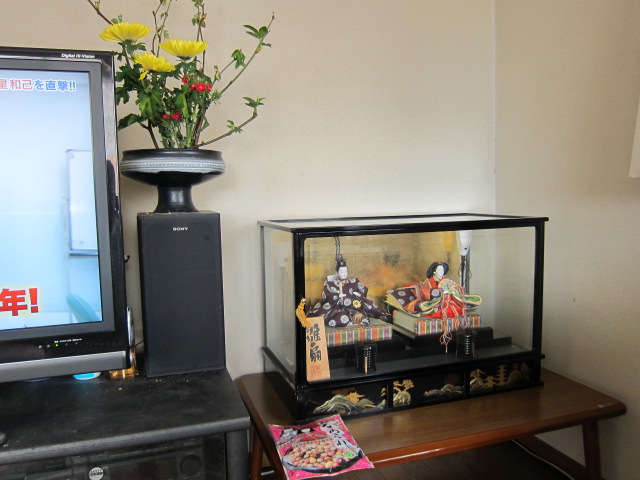
Once a year I put out this set of Hina dolls to celebrate "Hinamatsuri" or "the Hina dolls festival" on March 3. It is a festival for girls and wishes are expressed for their future happiness.
Customarily, hina dolls were sent by a mother's parents as a present when a girl baby was born. And these dolls were sent by my parents when my daughter was born 28 years ago. Considering the space for the dolls, I chose a set of only two dolls rather than that of gorgeous seven tiers.


This custom of displaying dolls began during the Heian period (8th century~12th century). In the past, people believed dolls had the power to contain bad spirits. And this festival dates back to an ancient Japanese custom of doll floating, in which straw hina dolls were set afloat on a boat and sent down a river to the sea, supposedly taking troubles or bad spirits with them.
Later during the Edo period (17th century~19th century), fabric Hina dolls wearing beautiful Heian nobility costumes appeared and they became popular and more gorgeous.


These dolls represent the Emperor and the Empress. The placement of a couple is different between the  western  (Osaka and Kyoto) and the eastern Japan ( Tokyo). The traditional arrangement had the male on the right from the viewer's perspective. But in the enthronement ceremony in 1926, Emperor Showa stood on the left side according to the Western style. Since then, the doll industry in Tokyo changed the arrangement in order to show their respect to Showa Emperor.On the other hand, Osaka and Kyoto preserved the former style.
But I forgot the story when I arranged this afternoon. I displayed the dolls according to the picture in the box. This is Tokyo style display. Never mind.


If my daughter has a girl baby next time, these dolls will be sent to her house for the baby. By that time, I will keep and display them every year. For my grandson Rintaro, we are planning to present a carp streamer for boys festival in May.